
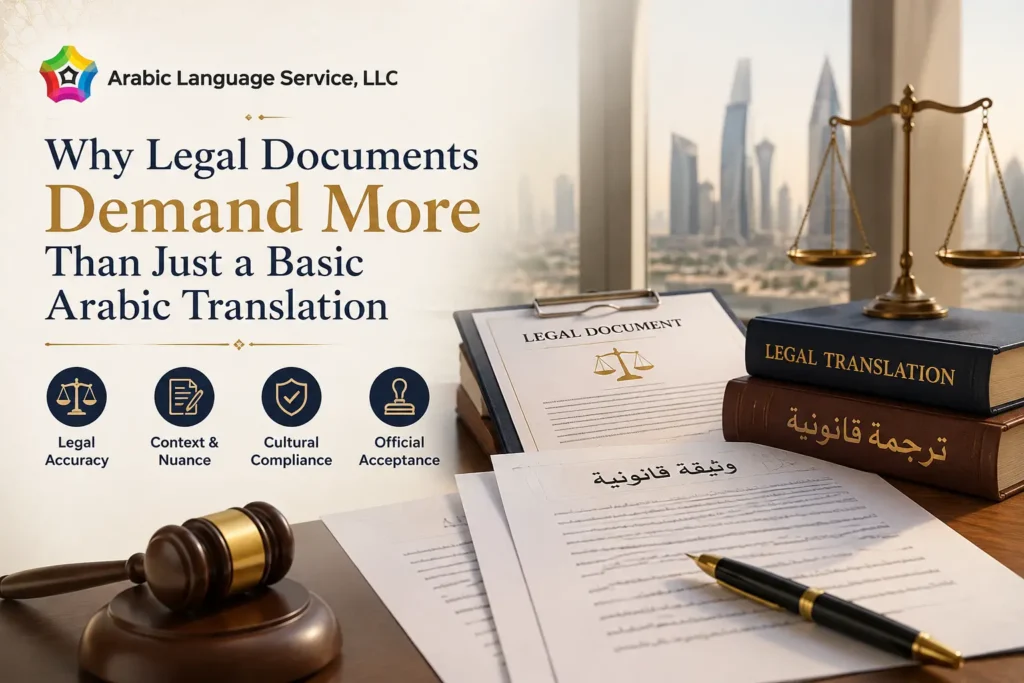
Legal paperwork just doesn’t leave much room for error. Anyone who’s actually needed arabic to english legal translation done right, not just adequately, figures that out fast. One mistranslated clause in a contract — or a phrase that’s slightly off in an affidavit — can shift the entire meaning of a document. Sometimes that carries real consequences, in court or during an official filing. Which is probably why so many people only go looking for proper translation help after discovering, the hard way, that a quick translation app just wasn’t built for this.
Legal Language Is Genuinely Its Own Challenge
Arabic legal terms often don’t map cleanly onto English at all. Some carry a specific legal weight in Arabic that gets completely lost in a literal, word-for-word rendering — and getting that wrong can change how a court, an immigration officer, or a business partner actually reads the document. That’s the core reason arabic to english legal translation needs someone fluent at a different level entirely: not just conversational Arabic, but legal drafting and formal terminology both.
Contracts. Court rulings. Affidavits. Power of attorney paperwork. Every one of these leans on precise wording, and a translator without legal background can miss subtleties that end up mattering a great deal once the document’s actually in use.
What Separates Real Legal Translation From the Generic Kind
Someone who handles casual conversation or everyday documents well doesn’t automatically have what legal work demands — it’s a different skill set, plain and simple. Proper arabic to english legal translation means understanding legal structure in both languages: how Arabic legal documents are typically formatted, and how that needs to carry over into English in a way courts and agencies will actually accept without pushback.
Certification counts for a lot here too. A good number of legal and government processes want certified translations specifically — accurate alone isn’t enough. Work that’s technically fine but missing proper certification can still get bounced, delaying cases or filings that usually already sit on tight deadlines.
Where This Kind of Translation Shows Up Most
Immigration cases probably top the list — birth certificates, marriage certificates, affidavits, all needing certified translation for USCIS or court submissions. Business contracts come up a lot too, especially cross-border deals involving the Middle East or North Africa, where one mistranslated clause could genuinely shift what both sides believe they’ve agreed to.
Court documents and legal correspondence make up another sizable chunk, particularly cases involving international parties where the original paperwork exists only in Arabic. Power of attorney documents and notarized agreements round it out, since these often need to hold up legally in more than one country at once.
Why Precision Wins Over Speed, Basically Always
Tempting as it is to chase a fast turnaround under deadline pressure, rushing arabic to english legal translation tends to backfire more than it helps. A translator who actually pauses to verify terminology, cross-check formatting expectations, and clarify anything ambiguous with the client ends up producing work that survives review by courts or agencies. Speed’s fine — sure — just never at the expense of accuracy in something carrying legal weight.
Communication Matters Just as Much as the Translation Itself
A good legal translator explains unclear terms rather than guessing at intent, and stays honest about realistic timelines instead of overpromising to land the job. Legal work often needs review, certification, or notarization stacked on top of the translation, so someone upfront about the whole process saves a lot of last-minute scrambling later.
Final Thoughts
Legal translation isn’t a spot where “good enough” really holds up — even small errors carry outsized consequences here. Taking the time to find someone genuinely experienced in arabic to english legal translation, instead of defaulting to whoever’s cheapest or fastest, tends to save a lot more trouble down the line — especially once courts, immigration offices, or contractual obligations get involved.