
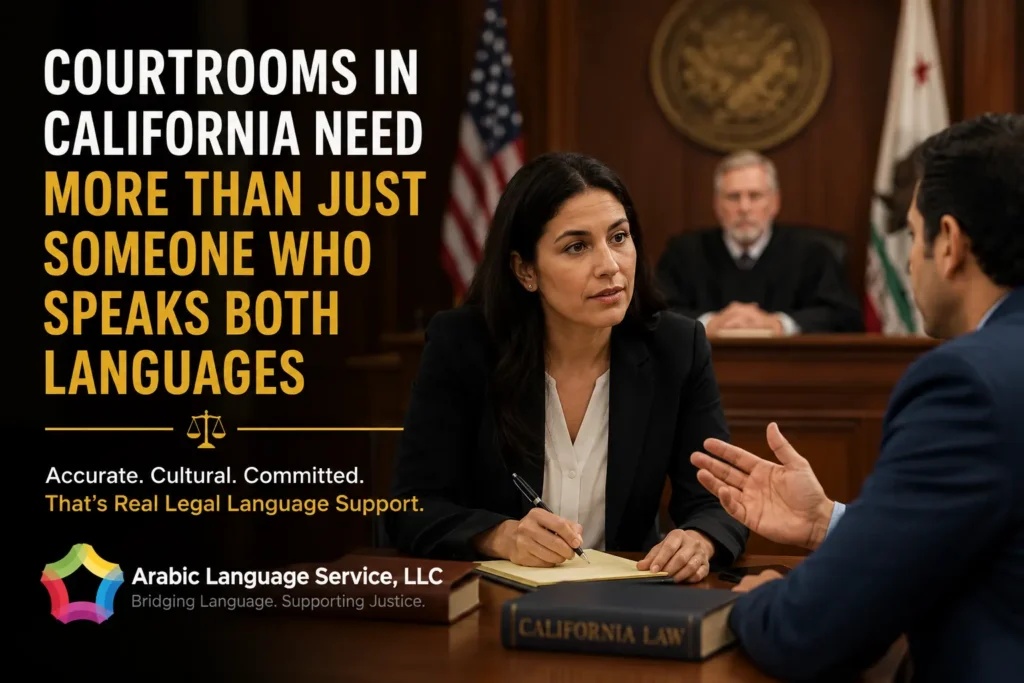
Court proceedings move fast. Precision matters more here than almost anywhere else, honestly. That’s why finding a qualified arabic court interpreter California courts will actually accept isn’t as simple as hiring anyone who happens to be bilingual. Legal interpretation is its own discipline, and getting it wrong can shift how a case turns out — sometimes significantly.
Fluency Alone Just Doesn’t Cut It
Arabic Court Interpreter California
Speaking Arabic well and interpreting it accurately in a courtroom — two different skills entirely. Proceedings move quickly. Testimony gets emotionally charged. Legal terminology carries specific weight that a casual interpreter could easily miss without even realizing it. An experienced arabic court interpreter California attorneys actually trust understands more than the language itself; they understand courtroom procedure. When to interpret word-for-word. When a cultural nuance needs quick clarification. How to keep pace during rapid exchanges without losing accuracy along the way.
Dialect matters too, more than most assume going in. Egyptian Arabic sounds nothing like Levantine or Gulf Arabic, and a witness’s specific dialect can affect how accurately testimony gets conveyed if the interpreter isn’t genuinely comfortable with that variation.
What Actually Makes Someone Qualified for This Work
California courts generally require certified interpreters, and that requirement exists for good reason. A certified arabic court interpreter California courts recognize has been tested specifically on legal terminology, ethics, and interpreting accurately under real pressure — not just casual conversational fluency. That distinction matters enormously in criminal cases, immigration hearings, civil disputes — basically anywhere a mistranslated word could shift the entire meaning of testimony.
Neutrality counts just as much, maybe more. A courtroom interpreter isn’t there to explain, summarize, or advocate for anyone. They’re there to interpret exactly what’s said — nothing added, nothing softened. Inexperienced interpreters sometimes get this wrong, usually without meaning to, but the consequences for the case are real regardless of intent.
Where This Kind of Interpretation Comes Up Most
Immigration hearings, probably the most common setting — so many involve Arabic-speaking petitioners or witnesses navigating a system that’s already unfamiliar and stressful on its own. Criminal proceedings come up a lot too: arraignments, trials, depositions, where a defendant’s right to fully understand what’s happening depends entirely on interpretation quality.
Family court matters — custody disputes, divorce proceedings — need interpretation often as well, frequently in emotionally difficult situations where precision and neutrality both matter a great deal. Civil litigation involving Arabic-speaking parties rounds things out, particularly business disputes where contract language and testimony both need accurate interpretation.
Why Local Experience Genuinely Matters
Working with an arabic court interpreter California courts already know smooths out a lot of procedural friction. Someone genuinely familiar with California court protocols, filing requirements, how local judges typically run things — that familiarity saves time, avoids the kind of procedural missteps that delay a case for no good reason.
Preparation and Professionalism Count Too
A good interpreter shows up prepared, having reviewed relevant terminology beforehand when that’s possible, and stays composed through tense or emotional testimony. They maintain strict confidentiality too, since court matters often touch sensitive personal or business information that shouldn’t circulate past the courtroom.
Final Thoughts
Court interpretation isn’t somewhere “close enough” holds up — accuracy directly shapes legal outcomes and someone’s actual right to a fair hearing. Taking time to find a properly certified arabic court interpreter California courts recognize, rather than defaulting to whoever’s cheapest or fastest available, matters far more than most people realize — until they’re sitting in that courtroom themselves.