
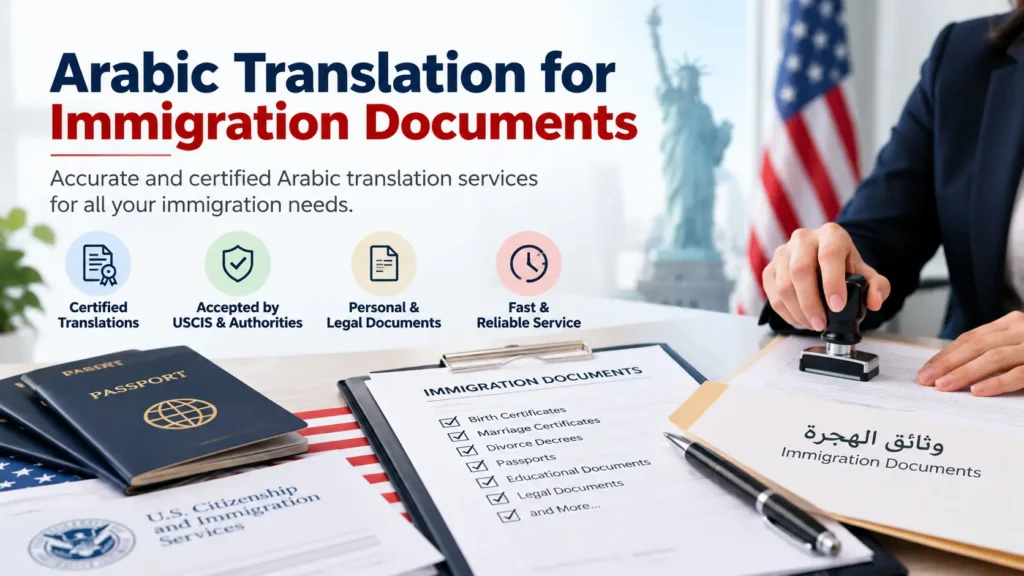
Arabic translation for immigration documents is the process of rendering Arabic civil, legal, academic and financial records into English, with a signed certification from the translator stating that the translation is complete and accurate. USCIS rules at 8 CFR 103.2(b)(3) require this for any foreign-language evidence, so a petition can stall if a single birth record, court order or diploma arrives without it. This guide explains which records need translation, how certification differs from notarization, and how to avoid the small inconsistencies that trigger requests for evidence.
Which Arabic Documents Usually Need Translation?
Immigration cases involve more paperwork than most applicants expect. Beyond birth, marriage and divorce records, officers may ask for police clearances, court judgments, military service records, employment letters and school transcripts. Each fits a different kind of document translation service: official document translation for government and civil records, academic document translation for diplomas and grades, and business document translation for company registrations, bank letters and contracts. Sorting your file into these groups early shows what a translator must handle. Immigration document translation also works best when you decide at the start which records are essential and which are optional supporting evidence. A tidy inventory also makes Arabic translation for immigration documents faster and easier to quote.
Certified or Notarized: What Each Step Actually Proves
Certified translation services produce a signed statement that the translator is competent in Arabic and English and that the text is accurate. Certified document translation services of this kind are generally what immigration authorities require. A notarization is a different thing. A notary confirms who signed the certification, not whether the translation is correct. Some courts, universities and foreign consulates still ask for Arabic notarized translation services, so check the receiving office’s exact wording before ordering. Someone searching for Arabic notarized translation Los Angeles courts will accept is usually asking for the same translation with the certification signed before a notary, not a second translation. Ask early, because redoing Arabic translation for immigration documents after notarization costs time and money.
Build a Name Map Before the Translation Starts
The most useful preparation habit costs almost nothing: write a one-page name map. List every family member’s name exactly as it appears on each passport, then add the Arabic spelling from the civil record. Arabic names transliterate in several valid ways, so Abd al-Rahman, Abdulrahman and Abdel Rahman can all be correct. Hand this sheet to your translator so every record uses identical spellings. For Arabic translation for immigration documents, mismatches between a visa form and a certified Arabic translation are among the most common reasons a reviewer pauses a file. Keep the sheet afterwards, since naturalization and later renewals draw on the same records.
Mixed-Script and Bilingual Records
Documents from the Maghreb often combine Arabic and French. Gulf records may carry English headings beside Arabic entries, and some stamps use Latin letters. A careful Arabic to English document translation covers all of it and labels each line by its original language where that helps. Handwritten registry entries need extra attention, because cursive Arabic can change meaning with a single dot. If a word cannot be read, the translator should mark it illegible rather than guess, and you should treat that note as a cue to request a clearer copy from the issuing office. Reliable Arabic translation for immigration documents never hides such gaps.
Arabic Legal Document Translation: Court Orders, Powers of Attorney and Affidavits
Arabic legal document translation demands more than fluency. Terms such as wakala (power of attorney), hukm (judgment) and mahr (marital payment) have no exact English equivalent, so a skilled translator keeps the Arabic term in transliteration and explains it in brackets. In Arabic to English legal document translation, this protects meaning, since a reader who sees the word dowry may miss that mahr is a contractual obligation. The same care applies to any legal document translation filed with a court, whether the matter concerns custody, property or a name change. Arabic translation for immigration documents often overlaps with these records.
English to Arabic Translation Services for Documents Going Overseas
Immigration rarely runs in one direction. Families also need American records, such as a divorce decree, marriage certificate or diploma, prepared for use in Arab countries. English to Arabic translation services in that situation usually sit alongside other steps: an apostille or authentication on the original, then the translation, and sometimes consular attestation. Requirements differ by country, so confirm the order of steps with the receiving authority before paying for anything. Translating first is a frequent and costly mistake, and it affects Arabic translation for immigration documents handled in reverse.
Choosing a Translator in San Francisco or Los Angeles
Location matters less than most people think, because Arabic translation services mostly work from scans. Still, searching for Document Translation in San Francisco or Document Translation in Los Angeles helps when an in-person notary signing is needed. Ask whether Arabic Document Translation San Francisco clients receive the same review as remote clients, and whether Arabic Legal Translation San Francisco work is checked by a second linguist. For Arabic Document Translation Los Angeles cases, which often involve large family files, ask how spelling stays consistent across every record. Professional document translation services should answer these questions plainly.
A Pre-Filing Audit for Certified Arabic Document Translation
Run this short audit on your Arabic translation for immigration documents before you submit anything.
- Every page is translated, including reverse sides, stamps and margin notes.
- Names match passports and forms exactly.
- Hijri dates carry a Gregorian equivalent in a translator’s note.
- The certification lists the translator’s name, signature, date and language pair.
- Each translation is attached to a copy of its original.
Whichever document translation service you choose, certified Arabic translation is only as strong as the preparation behind it. Certified Arabic document translation saves time when your files are tidy, and Arabic translation for immigration documents is mostly a matter of consistency.