
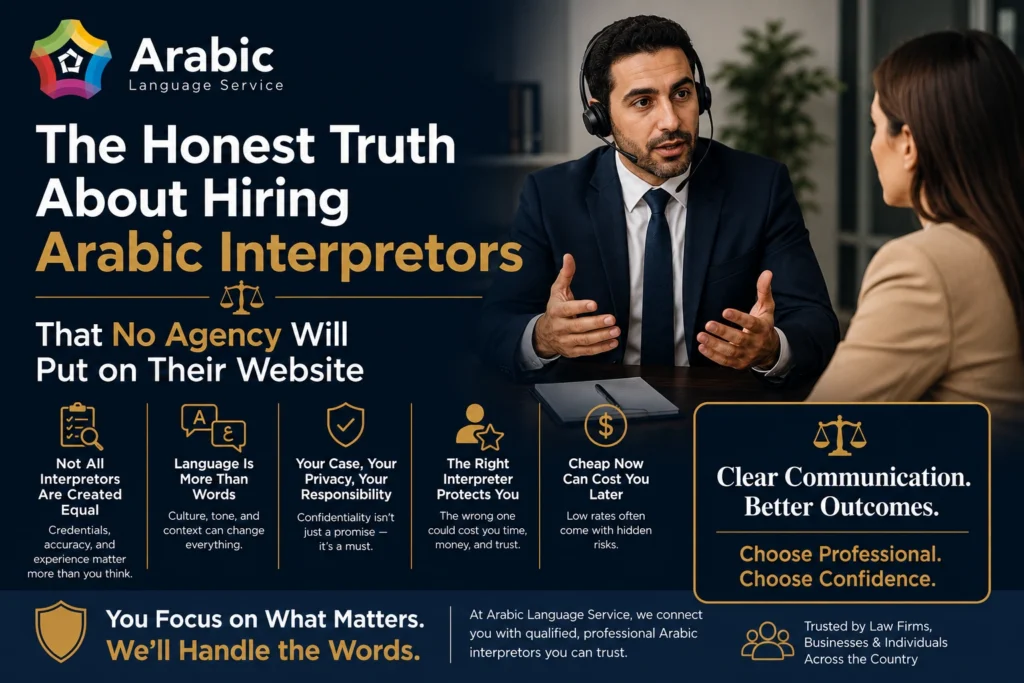
I’ve sat in rooms where interpretation went wrong.
Not catastrophically, not always — but wrong enough that you could see it on people’s faces. A witness in a deposition who keeps shaking their head slightly at what’s being attributed to her. A patient who nods along but clearly hasn’t understood the discharge instructions. A business meeting that technically concluded with an agreement but left the Arabic-speaking side visibly uncomfortable with something nobody named out loud.
The interpreter was present in all those situations. The interpretation was absent.
That’s the thing about arabic interpretors that’s genuinely hard to explain to someone who hasn’t experienced it — the gap between someone who speaks Arabic and someone who can actually interpret it in a live, high-pressure, consequential setting is massive. Enormous. And you usually only discover which kind you’ve got after the moment has already passed.
Arabic Isn’t One Language — It’s a Family, and That Changes Everything
Here’s where a lot of people’s assumptions fall apart.
They hear “Arabic interpreter” and they picture one language, one set of skills, one pool of qualified people. That’s not how it works. Modern Standard Arabic — the formal written register — is what you’ll find in newspapers, on Al Jazeera, in official speeches. Most educated Arabic speakers can read and understand it reasonably well. But almost nobody speaks it at home. At the dinner table. In a hospital waiting room when they’re frightened.
They speak Darija if they’re Moroccan. Levantine if they’re from Syria, Lebanon, Jordan, Palestine. Egyptian Arabic if they’re from Egypt — which, because Egyptian media has been so dominant for decades, tends to be the most widely understood spoken dialect across the region. Gulf Arabic if they’re from Saudi Arabia, Kuwait, the UAE. Iraqi Arabic. Yemeni. Sudanese. Each one different in ways that aren’t trivial.
So when you’re hiring arabic interpretors, the dialect question isn’t a secondary detail you get to after you’ve sorted out the price. It’s the first question. It should probably be the only question until it’s answered properly. An interpreter who is fluent in Egyptian Arabic and has never worked with Moroccan Darija is going to struggle — not fail necessarily, but struggle — in ways that will show up exactly when you can least afford it.
Consecutive vs. Simultaneous — What You’re Actually Choosing Between
Most people booking arabic interpretors for the first time don’t know this distinction exists, and it matters a lot.
Consecutive interpretation is the slower one. Speaker talks, pauses, interpreter renders it in the other language, then the speaker continues. It doubles the time of any conversation, which is either a minor inconvenience or a significant problem depending on your context. But it also allows for accuracy in a way that simultaneous simply can’t always match. The interpreter has a breath. They can choose the right word rather than the nearest one.
Simultaneous is the version you see with headsets at international conferences or in the UN General Assembly. The interpreter is speaking while the original speaker is still speaking, just a few seconds behind. It’s genuinely remarkable to watch someone do it well. It’s also exhausting in a way that’s hard to overstate — most professional standards cap it at 20 to 30 minutes before a second interpreter takes over. If you’re running a half-day conference, you don’t book one arabic interpretor. You book two, minimum.
Know which one your situation needs before you start making calls. It affects cost, logistics, and what kind of professional you’re actually looking for.
The Settings Where Getting This Wrong Has Real Consequences
Let’s be honest about what’s actually at stake in different contexts.
Courts are the obvious one. An Arabic-speaking defendant who can’t follow what’s being said about them in their own trial — that’s not just a communication problem, it’s a rights problem. Courts know this. Most jurisdictions require certified or sworn interpreters for criminal and immigration proceedings specifically because someone realized, at some point, that the consequences of error here are not recoverable. You don’t get to re-do a deportation hearing because the arabic interpretor missed a nuance.
Hospitals are similar, though the failure mode looks different. A patient who doesn’t understand their diagnosis may not follow their treatment plan. A family making decisions about surgery who didn’t fully grasp the risks — that’s informed consent that wasn’t actually informed. Medical arabic interpretors need clinical vocabulary, yes, but they also need to manage the emotional temperature of these conversations. Fear makes people hear selectively. A good interpreter knows how to pace information so it actually lands.
Business settings feel lower stakes but aren’t always. A failed negotiation because the Arabic-speaking party felt something got lost — and they weren’t wrong — can cost relationships that took years to build. Arab business culture tends to front-load relationship and trust before getting to commercial specifics. An interpreter who doesn’t understand that rhythm, who plows through pleasantries to get to the agenda, is subtly damaging the meeting even when every word is technically correct.
What “Certified” Actually Means — and Where It Falls Short
Certification matters. Genuinely. For legal settings especially, you often can’t use someone who isn’t certified — courts won’t accept their work. Organizations like the Chartered Institute of Linguists in the UK, or the court interpreter certification programs in the US, set real standards that involve testing and demonstrated competency.
But here’s what certification doesn’t guarantee: subject matter depth. A newly certified arabic interpretor who has never been inside a psychiatric evaluation is going to find that environment disorienting in ways that affect their work. The vocabulary alone — the clinical terms for mental states, the careful language used around suicide risk or psychosis — requires familiarity that comes from experience, not from passing a language exam.
Best case is both. Formally qualified and field-experienced. When you’re vetting arabic interpretors, ask about both. Separately.
Arabic Language Service — This Is Specifically What They Do
Finding genuinely qualified arabic interpretors across the full range of Arabic dialects, for specialized settings, with real subject matter experience — that’s not something a general staffing agency handles well. It requires a team that’s built around Arabic specifically, that has cultivated relationships with interpreters who’ve worked in courts, hospitals, boardrooms, community centers.
That’s what Arabic Language Service exists to provide. Not a dropdown on a website with Arabic listed between Amharic and Armenian. An actual specialization. Interpreters matched by dialect, by context, by the specific demands of your situation — whether that’s a one-hour medical consultation or a three-day international summit.
The people they work with are professionals. Not people who happen to speak Arabic. People who’ve made interpretation their work.
The Quiet Measure of Whether It Worked
When arabic interpretors do their job right, here’s what happens: nothing remarkable. The conversation flows. Both sides feel heard. Decisions get made. The meeting ends and people leave with an accurate shared understanding of what just occurred.
That’s it. No drama. No visible bridging of a gap. Just communication, functioning the way it was supposed to.
That invisibility is the whole point. And it’s worth hiring for deliberately rather than hoping you get lucky.