
Let me start with something most agencies won’t say out loud.
A lot of arabic to english translation services out there are, frankly, mediocre. Not fake. Not fraudulent. Just — mediocre. The words are technically transferred from one language to the other. Sentences exist. Paragraphs exist. And yet something essential is missing, like a meal that has all the right ingredients and still tastes flat.
I’ve seen legal documents that read like they were assembled by someone who understood Arabic and understood English but had never quite grasped how human beings actually communicate in either. I’ve seen marketing content so stilted that no native English speaker would ever believe it was meant for them. I’ve seen medical reports where the clinical precision of the original Arabic completely evaporated somewhere in the translation process.
This piece is about why that happens — and what separates the translation work that actually holds together from the kind that quietly fails the people depending on it.
Arabic and English Are About as Far Apart as Two Languages Get
Not in every way. But structurally? Significantly.
Arabic reads right to left. Its grammar operates on a root-and-pattern system where a three-letter root generates dozens of related words through predictable morphological changes — a system that has no real equivalent in English. Verbs often come before subjects. Nouns carry grammatical gender. The dual form exists for talking about exactly two of something, a distinction English doesn’t bother making. And then there’s the question of register — Modern Standard Arabic, the formal written language, sits at a considerable distance from the spoken dialects that most Arabic speakers use in daily life.
English, meanwhile, is notoriously loose in its grammar and notoriously dense in its idiomatic expressions. It borrows vocabulary from everywhere. Its word order conventions don’t always follow logical rules. Context carries an enormous amount of meaning that the words themselves don’t fully contain.
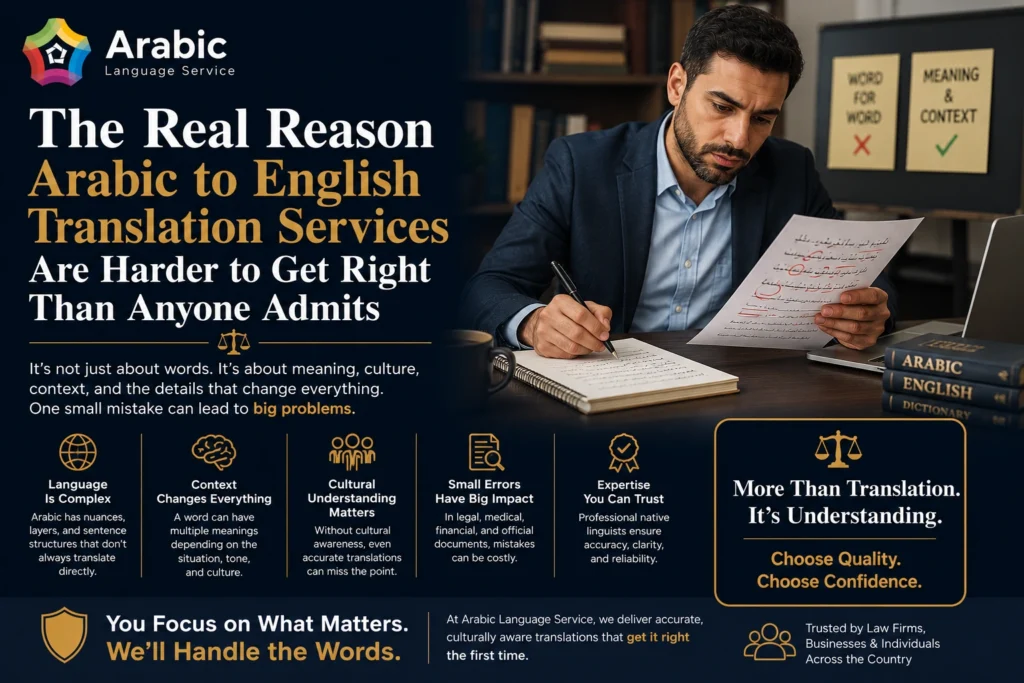
All of which means that arabic to english translation services can’t operate on a word-by-word substitution model. Every sentence is a judgment call. What does this phrase actually mean, not just literally but functionally? How does this rhetorical structure translate into something that reads naturally in English? Is this formal register going to land correctly with an English-speaking audience, or does it need adjustment?
These are questions that require actual human judgment. Every time.
The Types of Work That Come Through — and Why Each One Is Different
People seeking arabic to english translation services come from wildly different situations, and the skill set that serves them well isn’t the same across the board.
Legal translation is the category where errors have the most immediate consequences. Contracts. Court transcripts. Witness statements. Immigration paperwork. Intellectual property filings. In legal work, precision isn’t just preferred — it’s the entire point. One mistranslated clause in a contract can invalidate an agreement or create liability that nobody intended. One imprecise rendering of a witness statement can affect a case outcome. Legal translators working between Arabic and English need to know both languages and know how legal language functions in both systems — because legal systems don’t map neatly onto each other either.
Medical and pharmaceutical translation is equally demanding, just differently. Clinical trials. Patient records. Drug approval documents. Informed consent forms. The vocabulary is highly technical, the stakes around accuracy are obvious, and there’s an additional challenge — Arabic medical literature sometimes uses terminology that was developed separately from Western medical conventions, and bridging that requires genuine subject matter knowledge, not just language ability.
Business and commercial translation is where you start getting into the softer dimensions of language. An annual report needs to sound authoritative in English. A pitch deck needs to read with energy and clarity. Marketing content needs to actually connect with English-speaking audiences, which means sometimes you’re not translating so much as you’re recreating — keeping the intent and letting the form adapt. The best arabic to english translation services for business content understand this distinction and aren’t afraid to make those judgment calls.
Personal and official documents — birth certificates, marriage certificates, academic transcripts, diplomas — are often needed for immigration, study abroad applications, or professional licensing. These require certified translation in many contexts, meaning the translator attests to the accuracy of their work for official purposes. It sounds like a detail. In practice it determines whether the document gets accepted or rejected.
What Machine Translation Gets Right and What It Gets Badly Wrong
This question comes up constantly and it deserves a straight answer.
Machine translation has gotten genuinely impressive. If you paste an Arabic social media post into a translation tool and want a rough idea of what it says, modern AI will give you something surprisingly usable. For internal documents, quick comprehension, casual use — it works well enough.
But arabic to english translation services for anything that matters publicly or legally or professionally? Machines still fail in ways that are hard to predict and often hard to catch. Idiomatic expressions get rendered literally, producing sentences that mean nothing in English. Register gets flattened — formal Arabic becomes weirdly casual, or poetic Arabic becomes robotic. Cultural references get stripped of their meaning. Legal terminology gets substituted with the nearest English equivalent rather than the correct legal term of art.
The bigger problem with machine translation isn’t that the errors are obvious. It’s that they often aren’t. A document can look perfectly fine to someone who doesn’t know the source language. And then it gets used, and the problem surfaces in a way that’s expensive to fix.
Human translators catch what machines miss. Not because they’re infallible — they’re not — but because they’re reading for meaning, not pattern-matching for probability.
The Questions Worth Asking Before You Hire Anyone
When you’re evaluating arabic to english translation services, a few questions cut through the noise quickly.
What dialect of Arabic are they working from, and does their translator have genuine familiarity with that specific variety? Is the translator a native Arabic speaker, a native English speaker, or both — and which direction is their primary strength? Do they have subject matter background in your field, or are they a generalist? Can they provide certified translation if that’s what your documents require? And — worth asking directly — do they use machine translation as a first draft that a human then edits?
That last one is more common than agencies like to admit. It’s not automatically wrong, but you should know if it’s happening.
Arabic Language Service — Built Around Getting This Right
Arabic Language Service has built its work specifically around the demands of serious arabic to english translation services — not as one offering among dozens but as a core competency. Native Arabic speakers. Subject matter specialists across legal, medical, business, and official document translation. Certified translation available for documents requiring official attestation.
The work doesn’t start with a machine and end with a light edit. It starts with a human being who knows both languages and the subject matter deeply — and stays there.
The Quiet Standard
Good translation disappears. When arabic to english translation services are done right, an English reader picks up the document and reads it without once thinking about the language it originated in. The meaning is there. The tone is right. The technical terms are correct.
That’s the standard. Invisible. Accurate. Worth finding people who can actually meet it.