
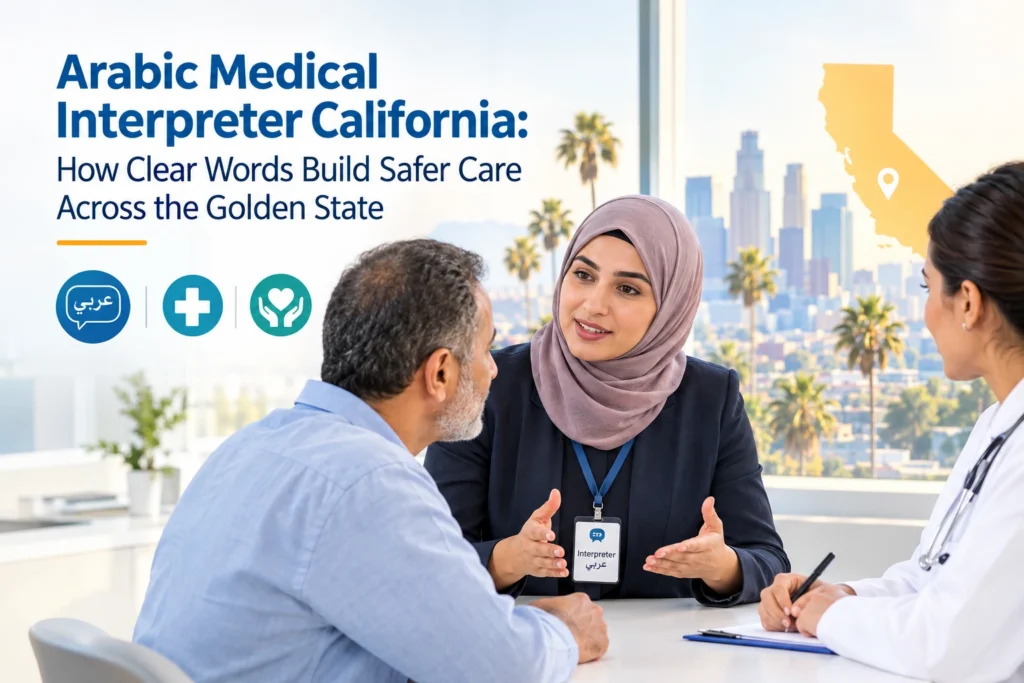
A young mother arrives at a pediatric clinic with a feverish toddler. She has rehearsed a few English phrases on the drive over, but when the doctor starts asking about rashes, fluid intake, and past vaccinations, her confidence fades. She nods along, unsure of what she just agreed to. This quiet struggle plays out in clinics every day, and it is the reason an arabic medical interpreter California families can depend on has become such a vital part of modern healthcare.
A Growing Need Across the State
Arabic speakers live in nearly every corner of California. San Diego County has welcomed thousands of Iraqi and Syrian refugees over the past two decades. The Bay Area hosts large Yemeni and Palestinian communities, while Sacramento and the Central Valley continue to see new arrivals from Egypt, Lebanon, and the Gulf region. Each group brings its own dialect and traditions.
More Than Translation in the Exam Room
An arabic medical interpreter California providers work with does far more than repeat sentences. They help a surgeon explain the risks of an operation, support a psychologist during a trauma counseling session, and make sure a pharmacist’s dosage instructions are understood word for word. Precision is everything. Confusing “twice a day” with “every two hours” could lead to serious harm.
Interpreters also serve as a bridge of trust. Many refugees have lived through war or displacement, and walking into an unfamiliar hospital can trigger anxiety. Hearing a calm voice in their own language often helps patients open up about symptoms they might otherwise hide.
The Challenge of Dialects
Modern Standard Arabic is used in news and writing, but everyday conversation happens in local dialects. A Sudanese patient and a Syrian patient may describe the same headache in completely different ways. Strong interpreters listen carefully in the first few minutes, identify the dialect, and adapt their word choices. When a term is unclear, they ask for clarification rather than guessing, because a guess in healthcare is never harmless.
Tips for Patients Who Need Language Support
If you or a loved one prefers Arabic during medical visits, a few simple steps can make appointments smoother. Mention your language preference when booking, so the office can arrange help ahead of time. Bring a written list of medications and symptoms. Speak in short sentences, and never hesitate to say you do not understand. Requesting an arabic medical interpreter California law protects your access to is your right, not an inconvenience to staff.
Guidance for Healthcare Providers
Providers can also improve these conversations. Look at the patient, not the interpreter, when speaking. Pause after two or three sentences so the message can be relayed accurately. Avoid slang and medical shorthand. Allow extra appointment time, since interpreted visits naturally take longer. Avoid relying on children or relatives to interpret.
Remote Options for Rural Communities
Distance once made language access difficult outside major cities. Today, video and phone interpreting allow a small clinic in the desert or the mountains to connect with a qualified professional within minutes. While in-person support remains ideal for sensitive discussions, remote services have closed a gap that once left many patients without any help at all.
Closing Thoughts
Language should never stand between a person and the care they deserve. As California’s Arabic-speaking population continues to grow, the role of an arabic medical interpreter California hospitals and clinics rely on will only become more important. Choosing a skilled arabic medical interpreter California patients feel comfortable with is one of the simplest ways to make healthcare fair for everyone.