
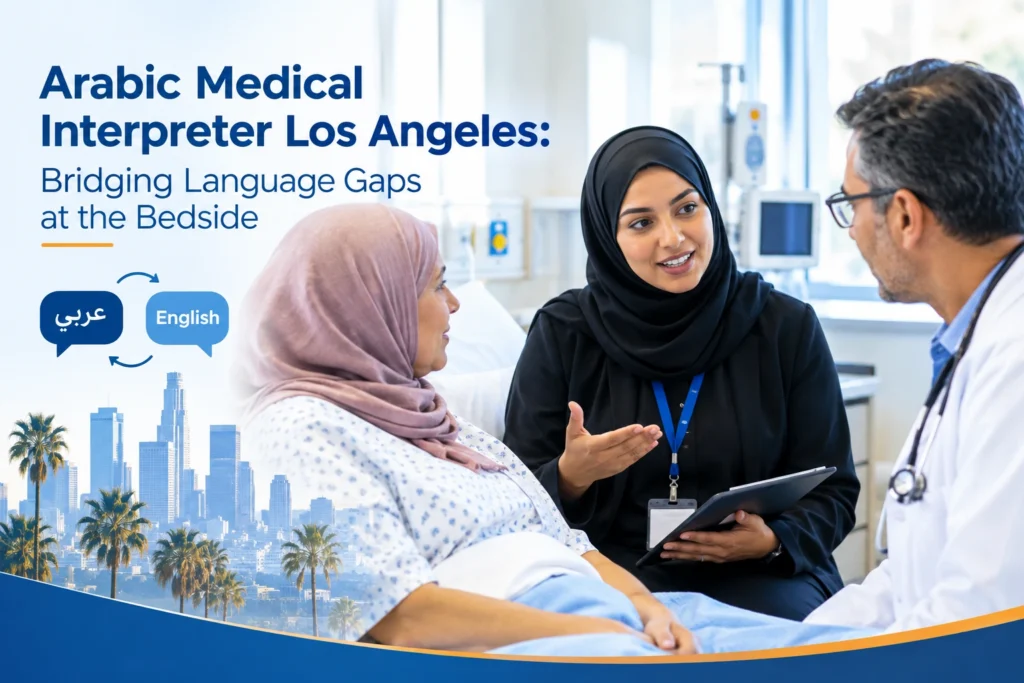
Picture an elderly man from Baghdad in a crowded emergency room, clutching his chest and trying to explain that the pain spreads to his left arm. The nurse nods politely, but neither understands the other. Moments like these happen more often than most people realize, and they show exactly why an arabic medical interpreter Los Angeles hospitals and clinics rely on can be the difference between a correct diagnosis and a dangerous mistake.
Why Language Access Matters in Southern California Healthcare
Los Angeles is home to one of the largest Arabic-speaking communities in the United States. Families from Egypt, Lebanon, Syria, Iraq, Yemen, and beyond live across the region. Many residents speak English comfortably in daily life, yet medical conversations are a different story. Terms like “benign,” “biopsy,” or “contraindication” can confuse even fluent speakers, especially when fear and stress are involved.
What an Arabic Medical Interpreter Actually Does
Interpreting in a clinical setting is far more than swapping words from one language to another. A skilled arabic medical interpreter Los Angeles patients trust must accurately convey meaning, tone, and urgency while remaining neutral. They help during doctor consultations, surgical consent discussions, mental health sessions, discharge planning, and prenatal appointments.
Arabic also presents a unique challenge because of its many dialects. Egyptian Arabic sounds quite different from Iraqi or Moroccan Arabic, and a single word can carry different meanings from one region to another. An experienced interpreter quickly identifies the patient’s dialect and adjusts, ensuring nothing is lost along the way.
Cultural Sensitivity Is Just as Important as Vocabulary
Healthcare is deeply personal, and cultural values shape how people talk about illness. Some patients prefer a family member to be present during serious discussions. Others may feel uncomfortable discussing reproductive health with a provider of the opposite gender. Fasting during Ramadan can also affect medication schedules.
A thoughtful interpreter notices these details and gently helps both sides understand each other. They do not give medical advice or add personal opinions, but they can flag cultural misunderstandings so the care team can respond respectfully.
Qualities of a Reliable Medical Interpreter
Not everyone who speaks two languages is ready to interpret in a hospital. The strongest professionals share several traits: fluency in both English and Arabic, solid knowledge of medical terminology, strict confidentiality, and the ability to stay calm in high-pressure situations. Many also hold national certification.
Accuracy is non-negotiable. Adding, leaving out, or softening information can change a treatment outcome.
In-Person, Phone, or Video Interpreting
Healthcare facilities now use several formats depending on the situation. On-site interpreting works best for complex conversations, such as cancer diagnoses or end-of-life care, where body language matters. Video interpreting offers a visual connection when an in-person option is not available. Phone interpreting suits quick questions and scheduling. Choosing the right arabic medical interpreter Los Angeles format depends on urgency, sensitivity, and the patient’s comfort level.
Patient Rights and Legal Requirements
Federal law requires most healthcare providers receiving public funding to offer language assistance at no cost to patients with limited English proficiency. Patients have the right to request a qualified interpreter rather than relying on children, friends, or untrained staff.
Final Thoughts
Good healthcare begins with understanding. For thousands of Arabic-speaking families, having an arabic medical interpreter Los Angeles providers can call upon means feeling heard, respected, and safe. Asking for an arabic medical interpreter Los Angeles facilities are required to provide is not a favor; it is a basic part of quality care.