
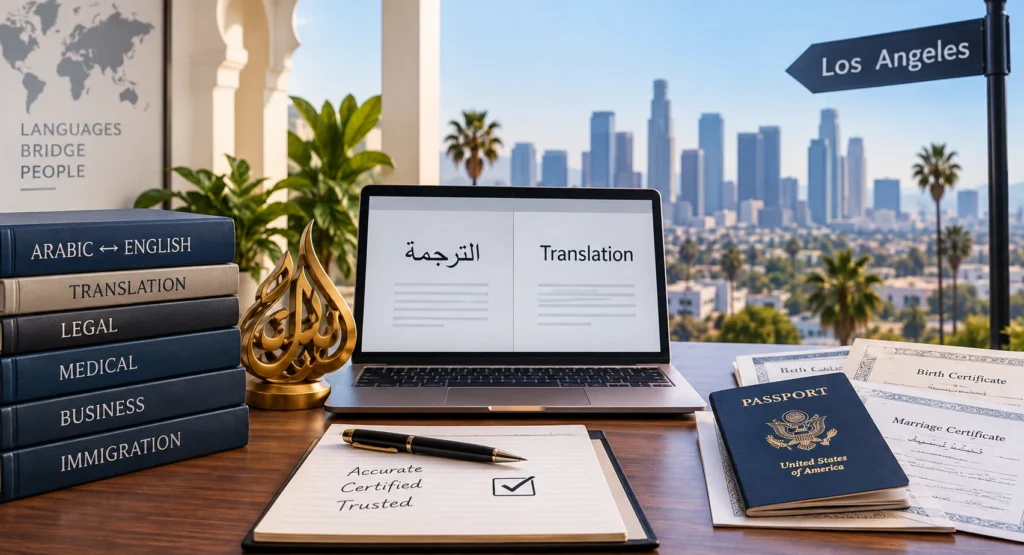
Quick answer: Arabic translation services in Los Angeles handle certified document translation, legal and medical interpreting, and transcription for courts, USCIS filings, hospitals, universities, and businesses across LA County. Consider one as soon as an Arabic document or spoken statement has to be accepted by a U.S. institution. The decision hinges on two things most buyers overlook: whether the linguist holds a credential you can verify on a public registry, and whether they work in the specific Arabic dialect your document or speaker actually uses.
What Do These Services Cover?
Arabic translation services fall into four working categories, and mixing them up is the most common source of wasted time.- Certified document translation: a full English version of the original, including seals, stamps, and handwriting, with a signed accuracy statement
- Interpreting: live spoken language for depositions, hearings, medical visits, and meetings, delivered on site, by phone, or by video
- Transcription: Arabic audio and video turned into a written record
- Localization: contracts, manuals, websites, and software adapted for Arabic-speaking markets
When Does a Certified Translation Become Mandatory?
It becomes mandatory the moment a federal or state body will rely on the document as evidence. For immigration matters, federal regulation 8 CFR 103.2(b)(3) requires every foreign-language document submitted to USCIS to arrive with a complete English translation plus the translator’s certification of accuracy and competence. Partial translations and summaries do not satisfy it. California adds a second layer. Under Government Code section 27293, a county clerk may certify a document translated into English only if the translation was produced by an American Translators Association certified translator, a California Certified Court Interpreter, or a California Registered Interpreter. If your document is headed to a county clerk, credentials are not a preference. They are the gate.Who Typically Needs Arabic Translation Services in Los Angeles?
- Immigration attorneys and applicants submitting Arabic birth, marriage, divorce, and police records
- Litigators needing Arabic to English legal translation of contracts, foreign judgments, and exhibits
- Hospitals, clinics, and clinical research teams working with Arabic-speaking patients
- Universities and licensing boards evaluating Arabic transcripts and diplomas
- Companies expanding into Gulf and North African markets
Why Dialect Decides the Outcome
Official Arabic documents are written in Modern Standard Arabic. Almost nothing spoken is. Gulf, Levantine, Egyptian, Sudanese, Moroccan, Maghrebi, Mesopotamian, and Yemeni Arabic differ in everyday vocabulary, name transliteration, and date conventions. In an asylum interview or a deposition, a linguist working outside the speaker’s dialect will approximate, and approximations become contradictions on the transcript. Always state the speaker’s country of origin when booking, not just the language. Many people search for an “arabic interpretor” and accept the first available name without asking this question. That is how a Sudanese witness ends up with a Levantine-only interpreter and a record that has to be corrected later. Arabic Language Service is led by Ayad Kholaifat, a court-qualified interpreter credentialed by the Superior Court of California and an American Translators Association associate member (M-197712), with working coverage across Gulf, Levantine, Egyptian, Sudanese, and Maghrebi dialects.How to Verify a Provider Before You Commit
Do these four checks. They take minutes and eliminate most risk.- Search the public registry. The Judicial Council maintains a searchable Master List of certified court and registered interpreters by language and county. In February 2025 its Language Access Services unit issued an advisory after reports of people impersonating credentialed interpreters in private settings such as depositions, and recommended verifying against the Master List before hiring.
- Ask who signs the certification. You want a named individual with a number you can check, not an anonymous statement on letterhead.
- Confirm the dialect assignment in writing. Before the date, not on the day.
- Ask what the review step is. Numbers, dates, and registry codes are where errors hide, and a second pass is what catches them.
Mistakes That Cause Rejections and Reschedules
- Translating only the pages that seem relevant instead of the entire document
- Leaving seals, stamps, and margin notes untranslated
- Using inconsistent English spellings of the same Arabic name across one filing
- Paying for notarization the receiving agency never asked for
- Assuming one certification covers a stack of documents when each usually needs its own
- Booking too late, which removes the option of careful review
What the Workflow Should Look Like
- Send clear scans of every page, front and back
- State the purpose and the receiving institution, since that determines certification format
- Receive a quote, typically within one hour
- Approve scope and turnaround
- Review and quality check
- Delivery with certification attached
Key Takeaway
Before you pay, confirm three things: the credential appears on a public registry, the assigned dialect matches your document or speaker, and the certification format matches what the receiving institution specifically requires. Ask for those in writing at the quote stage. Every avoidable rejection, reschedule, and reprint traces back to one of them being skipped.Request a Quote
Send your documents or describe your hearing, deposition, or appointment, and get a quote along with a clear answer on what certification your matter actually requires. Arabic Language Service provides certified translation, interpretation, and transcription for Los Angeles, San Francisco, and Anaheim. Call +1 (415) 412-3475, email info@arabiclanguageservice.com, or upload your files through the contact page. Offices at 1840 Van Ness Ave, San Francisco, CA 94109, and 214 N Ventura St, Anaheim, CA 92801.Frequently Asked Questions
Do Los Angeles and San Francisco follow different standards?
No. Requirements are statewide. Only logistics differ, since on-site work involves travel and scheduling. Certified Arabic translation in San Francisco, Los Angeles, and Anaheim follows the same certification rules.
Is a certified translation the same as a notarized one?
No. Certification is the translator's signed accuracy statement. Notarization only confirms the signer's identity. USCIS requires certification, not notarization, though some consulates and schools ask for both.
Can a bilingual relative translate my documents?
For informal use, yes. For filings, no. Someone with a direct interest in the outcome invites scrutiny, and county clerks cannot certify translations from uncredentialed translators.
How do I check that an interpreter is genuinely credentialed?
Search the Judicial Council's Master List by language and county. Credentialed interpreters also carry a Judicial Council badge showing a photo, official title, identification number, and expiration date.
How is pricing normally calculated?
Written translation is priced per page or per word depending on complexity. Interpreting is priced hourly or by half day, with minimums for on-site assignments. Ask for a written quote tied to your actual page count.
How quickly can documents be delivered?
Single-page civil records are commonly completed within one to two business days, and same-day handling is available for urgent cases. Handwritten or damaged originals take longer because legibility must be confirmed first.
Does a court interpreter automatically certify written translations?
Not necessarily. California Certified Court and Registered Interpreters are authorized to interpret documents orally in proceedings, but the Judicial Council does not test written translation ability. It is a separate skill set.
Can I use machine translation for official filings?
It should not be used. Automated tools mishandle dialect, legal register, handwriting, and seals, and no software can sign a competent-translator certification.
What happens if part of my document is illegible?
A professional labels the section as illegible rather than guessing. Inventing content in a certified translation creates a serious problem if the filing is later examined.
Do you assist with apostille and overseas submissions?
Yes. Assistance with apostille preparation is available, alongside notarized translations of birth, marriage, divorce, and education records being sent abroad.